Certified Counterintelligence Threat Analyst (CCTA)
The full credential for working professionals.
Complete curriculum, mentorship, and proctored exam included.
Certified Counterintelligence Threat Analyst (CCTA)

The Certified Counterintelligence Threat Analyst program prepares intelligence, security, investigative, and cyber professionals to identify insider and external threats, evaluate behavior and intent, analyze digital and open-source activity, and develop defensible mitigation recommendations.
Scholarship rate shown
or pay over time with Affirm · Sezzle
Military / Gov COOL and TA eligible
Threat activity may emerge through unusual access, online behavior, deceptive communication, social relationships, shifting loyalties, digital indicators, or attempts to collect sensitive information. Analysts must evaluate these signals in context, distinguish legitimate activity from meaningful risk, document uncertainty, and coordinate protective action without relying on assumptions or profiling alone. CCTA is designed for professionals who need a structured framework for identifying, analyzing, documenting, and mitigating insider, cyber-enabled, and external counterintelligence threats.
Threat indicators are missed when cyber activity, human behavior, social media, access patterns, and organizational information remain separated.
Assessments lose credibility when intent, capability, opportunity, source reliability, and analytical uncertainty are not documented.
Organizations remain exposed when intelligence findings do not lead to proportionate, lawful, and actionable mitigation recommendations.
CCTA provides a structured approach to counterintelligence principles, threat identification, behavioral analysis, digital and open-source investigation, deception indicators, cyber-threat activity, legal considerations, and mitigation planning.
Connects behavioral, digital, social-media, open-source, cyber, and organizational indicators within a unified counterintelligence assessment process.
Develops the analytical judgment needed to evaluate what a subject may intend, what access or capability exists, and whether conditions support meaningful risk.
Moves from threat identification and intelligence collection into assessment, documentation, legal considerations, and protective recommendations.
Certification requires completion of the applicable training, eligibility, assessment, and proctored examination requirements. Access to the program alone does not result in certification.
Self-pay, military/government funding, or employer sponsorship — we'll take you to the right option.


Board certification programs: Students must submit all course quizzes, score 70% or better on all sections of the course and obtain a 70% or better on the final online examination, and submit proof eligibility up completion of your exam application. All fees must be paid in full. Upon successful completion of your program, the McAfee Institute will issue your board certification. Students who successfully complete the program before meeting the eligibility will be put into a holding pattern until the eligibility is met at which time the credentials will be issued.
Completion of training does not guarantee employment, promotion, security clearance eligibility, or acceptance by any agency or third party.
Eligible for military & government credentialing assistance


Select certification programs may be eligible for use with military and government credentialing or tuition assistance benefits, subject to agency and individual eligibility requirements. Participation does not imply endorsement by any agency.
State & Federal Regulatory Approvals
State-certified to operate under 6 CSR 10-5.010
Dept. of Higher Education and Workforce Development
Listed training provider, NICCS Education & Training Catalog
Mapped to NIST NICE framework · operated by CISA
40 CLEE hours approved · Control #14976
10 legal studies · 30 technical studies
Officers should confirm acceptance with their licensing agency.
Understand the fundamentals of counterintelligence, from intelligence gathering to analysis, enabling you to lead sophisticated cyber investigations.
Dive deep into social media platforms to uncover potential threats. Learn advanced tactics for analyzing social media content and identifying deception in online interactions.
Acquire skills in both classified and open-source intelligence gathering, using real-world tools and techniques to support cyber investigations.
Explore the deep web for hidden information critical to investigations. Learn advanced search techniques to locate valuable data efficiently and securely.
Develop profiling skills to assess cyber threats, understanding the motivations and methods of cyber criminals and hackers.
Gain hands-on experience in digital forensics, including email header analysis, to trace and investigate cyber incidents effectively.
Navigate the legal and ethical challenges in cyber counterintelligence, ensuring compliance with industry standards while conducting complex investigations.
Study cyber terrorism tactics and methodologies, equipping yourself to counter threats that impact national security.
Real feedback from professionals who've completed this program
“Great course. I would recommend this for those who lack the knowledge for investigations using open source intelligence. The structure and progression of this course was very good.”
Charles T.
Verified Graduate
“Outstanding program! I highly suggest any information security professional to sign up! The customer support was top notch as well!”
Kenneth Mackiewicz
Verified Graduate
“This was a fantastic course!! I enjoyed learning new investigative methods/strategies and applying them immediately.”
Brian Mills
Verified Graduate

15 years building credentials for the professionals who actually do the work. CCTA was developed alongside practitioners from federal, state, and corporate investigation teams.
CCTA is designed for professionals whose work involves insider risk, counterintelligence, cyber threats, security investigations, intelligence analysis, organizational protection, digital evidence, or the assessment of adversarial behavior.
Law Enforcement and Intelligence Officers who require advanced cyber investigation techniques to enhance their fieldwork and strategic counterintelligence operations.
Cybersecurity Professionals and IT Specialists eager to expand their skills in digital forensics, intelligence methodologies, and cyber threat analysis.
Corporate Security and Risk Management Experts looking to apply counterintelligence strategies to protect organizational assets and mitigate cyber threats.
Government and Military Personnel responsible for safeguarding national security, with a focus on understanding and countering cyber terrorism.
Private Investigators and Cyber Consultants seeking to gain specialized expertise in counterintelligence and improve investigation outcomes for high-profile cases.
You are seeking general cybersecurity or network-defense training without an intelligence or threat-analysis focus.
Your role does not involve intelligence, investigations, security, insider risk, cyber threats, fraud, compliance, or organizational protection.
You want a purely technical digital-forensics or penetration-testing certification.
You are looking for a brief awareness course rather than a structured professional certification with analytical and assessment requirements.
You are unwilling to distinguish evidence from inference, document uncertainty, test competing explanations, and make proportionate recommendations.
Program-fit questions candidates ask before they enroll.
No specialized counterintelligence background is required beyond the published eligibility standards. The program develops a structured understanding of threat identification, intelligence collection, behavioral analysis, digital investigation, legal considerations, and mitigation.
McAfee Institute trains military, law enforcement, and investigative professionals. Eligibility reflects that. Verification is the reason the credential carries weight in the field.
Any one of the qualifying paths below. Experience must be in investigations, law enforcement, criminal justice, military, or similar fields with direct criminal investigation or intelligence responsibilities.
Path A Bachelor's or higher + 3 years experience
Path B Associate's degree + 4 years experience
Path C HS diploma or equivalent + 5 years experience
Relevant fields include investigations, law enforcement, criminal justice, military, and/or another similar field with direct criminal investigation and/or intelligence responsibilities.
Applicants are not eligible with any felony conviction or pending felony charge, or any conviction or pending charge involving violence, dishonesty or breach of trust, or crimes against persons, or other disqualifying offenses. Criminal history must be disclosed at enrollment and may be verified.
McAfee Institute is a U.S.-based institution serving a primarily U.S. professional audience. International enrollments may be subject to additional review, identity verification, professional affiliation verification, and compliance screening. Applicants located in certain countries or regions, or associated with restricted persons or entities under U.S. law, may be ineligible for enrollment.
Scholarship rate shown
or pay over time with Affirm · Sezzle
Military / Gov COOL and TA eligible
Read the full eligibility and conduct policyApplicants must disclose criminal history as requested during enrollment. McAfee Institute may verify eligibility through documentation and/or a background check when required by a program component, partner environment, exam vendor, or when reasonably necessary to protect program integrity. Disclosures are required to the extent permitted by applicable law.
Any material falsification or omission is grounds for denial of admission, removal from the program, and/or denial of certification.
Completion of training does not guarantee employment, promotion, security clearance eligibility, or acceptance by any agency or third party.
The CCTA curriculum progresses from counterintelligence principles, the intelligence cycle, collection disciplines, privacy, and secure research environments into social-media investigations, deep-web research, deception analysis, behavioral threat assessment, digital forensics, email analysis, cyberterrorism, and applied intelligence methodology. Across 19 modules and 40 hours of instruction, learners examine how threat indicators can be collected, evaluated, connected, documented, and translated into mitigation recommendations.
19 modules · 169 lessons of structured coursework, board-aligned and tested in the final exam.
This program is mapped to measurable performance objectives used for academic review, assessment alignment, and continuous improvement.
Identify counterintelligence principles, threat typologies, and legal considerations relevant to national and organizational security.
Apply counterintelligence techniques across social media, deep web, and behavioral threat domains.
Produce a counterintelligence threat assessment incorporating analytical reasoning, legal compliance, and mitigation recommendations.
Advanced training in counterintelligence operations, threat analysis, and security countermeasures. Learn to identify, assess, and neutralize intelligence threats to organizations and national security.
The Certified Cyber Counterintelligence Threat Analyst (CCTA) program by McAfee Institute offers elite training for professionals in law enforcement, intelligence, and cybersecurity. This rigorous certification program provides the expertise needed to tackle evolving cyber threats and safeguard national security. CCTA-certified professionals are highly regarded across government agencies and the private sector for their ability to perform complex cyber investigations and counterintelligence operations.
Through a blend of self-paced online modules, real-world exercises, and live instructor support, you’ll master advanced methodologies in counterintelligence, social media analysis, deep web navigation, and digital forensics. The CCTA credential signifies not just proficiency but a strategic advantage in the fight against cybercrime.
One enrollment includes the full course library, the official manual, the proctored exam license, and your board credential on completion.
Join a comprehensive professional development platform designed exclusively for law enforcement, intelligence, and investigation professionals.
Engage with verified professionals in law enforcement and intelligence
Access career opportunities not listed elsewhere
Automatic continuing professional education credit management
Connect with federal agents and industry leaders
Join private discussion groups with peers
Articles, whitepapers, tools and more
One credential. Three eligibility paths. Pick yours.
The full credential for working professionals.
Complete curriculum, mentorship, and proctored exam included.
Same program, same exam, same credential. Open to anyone with a Bachelor's degree, no work experience required.
Designed for those entering the field who don't yet meet the Certification's experience requirements.
For experienced practitioners ready to validate without taking the training.
Standalone exam — does not include curriculum, study materials, or mentorship.
Self-pay · Military / Gov COOL · Employer-funded
For individual students paying out of pocket. Employer-funded, team, or military/government-funded enrollments use the Standard Institutional Rate.
3-day money-back guarantee
Interest-free via Affirm or Sezzle. 6–12 month plans available.
Military / Gov COOL eligible? Use DoD/Navy/Army/Coast Guard/Air Force COOL or TA funding — switch to the tab for the invoice request flow.
Need financial help? — available for self-paying students demonstrating financial need.
Scholarship price available for individual students paying out of pocket only.
Not valid for employer-funded, organizational, team, Military / Gov COOL, or third-party paid enrollments.
Talk to an advisor about eligibility, fit, and funding paths.
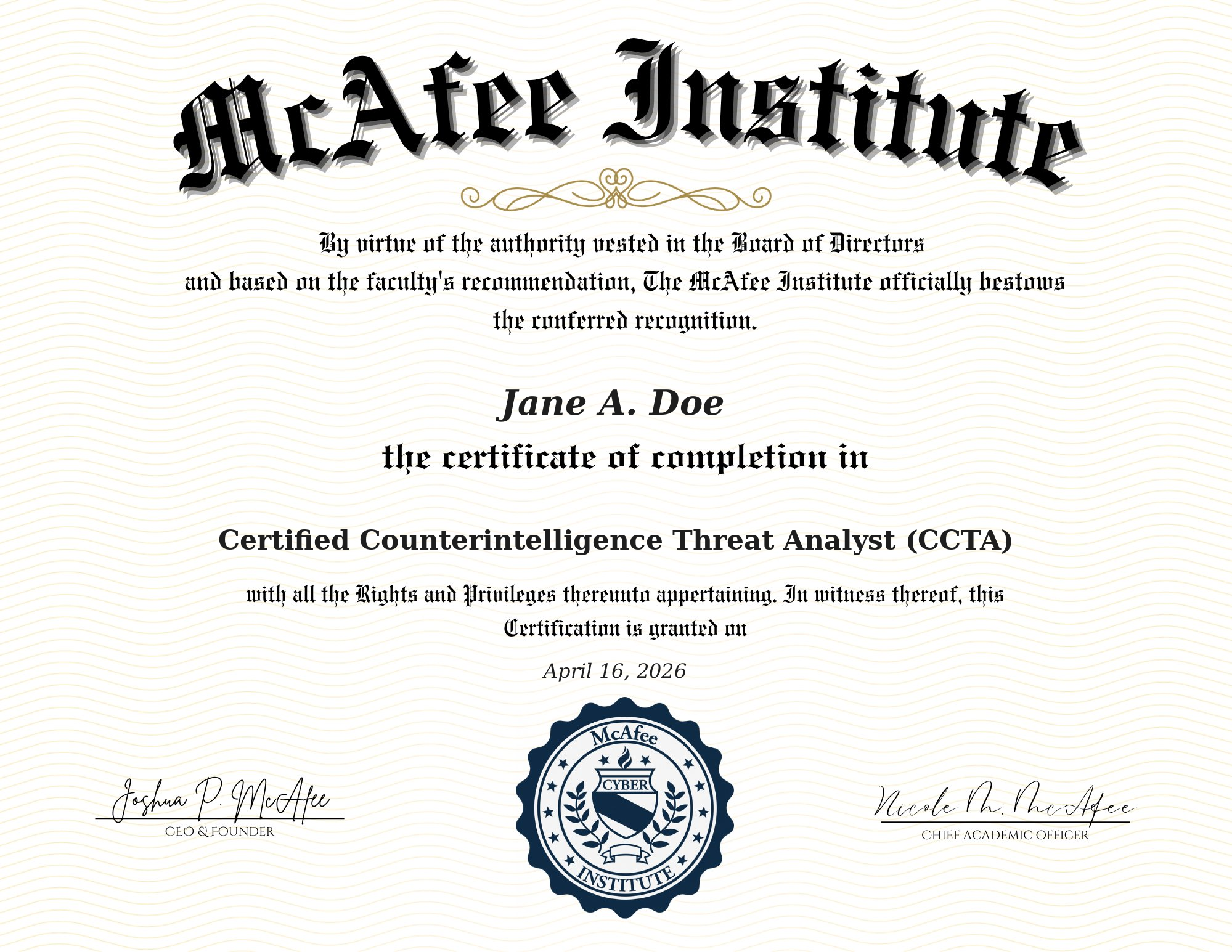
Complete the CCTA certification process and document specialized education and assessment in counterintelligence principles, insider-threat analysis, behavioral indicators, digital and open-source investigation, deception analysis, legal considerations, and mitigation planning.
We use cookies to analyze traffic and personalize content. You can opt out at any time. See our Cookie Policy.
We use cookies to analyze traffic and personalize content. You can opt out at any time. Learn more in our Cookie Policy.